The Application of Flowmeters in the Production Process of Papermaking Pulp Barrels

In the pulping process of the papermaking industry, the pulping barrel, as the core equipment, undertakes the key tasks of mixing pulp with water, dispersing fibers and homogenizing the pulp. The precise monitoring and control of the flow rate throughout the entire process from the preparation of the pulp to its transportation to the subsequent pulp box directly determine the stability of the pulp concentration, production efficiency and the final quality of the paper. As the core monitoring equipment for achieving this goal, the rational selection and standardized application of flowmeters play an irreplaceable role in the smooth operation of the pulping process.
The core role of flowmeters in the pulping process
The core working logic of the pulping tank is to mix the pulp fibers with water into a uniform pulp through stirring, shearing and temperature control, and then precisely convey it to the pulp box to complete the subsequent forming process. In this process, the role of the flowmeter is mainly reflected in three key nodes:
1. Inlet water flow control: During the pulping process, the ratio of pulp to water directly affects the pulp concentration. The flowmeter needs to monitor the flow of clear water entering the pulping tank in real time to provide data support for the proportioning system, ensuring that the mixing ratio of fibers to water meets the process requirements and avoiding the pulp being too thin due to excessive water or uneven fiber dispersion due to insufficient water.
2. Slurry output monitoring: The homogenized slurry needs to be stably conveyed to the pulp box. The flowmeter can capture the fluctuation of the output flow in real time and promptly feed it back to the control system to adjust the discharge rate of the pulping bucket, avoiding abnormal liquid level in the pulp box due to sudden changes in the supply volume and ensuring the uniformity of subsequent paper forming.
3. Circulation flow regulation: In some pulping processes, a slurry circulation pipeline is set up to enhance the homogenization effect. The flowmeter can monitor the flow data in the circulation pipeline, assist the control system in optimizing the circulation rate, ensure consistent slurry concentration in the pulping tank, and avoid energy waste at the same time.
2. Mainstream flowmeter types and working processes in pulping scenarios
Considering the characteristics of the slurry in the pulping process, such as containing fibers, having a certain viscosity and possibly impurities, the flowmeters currently widely used mainly include electromagnetic flowmeters, vortex flowmeters and ultrasonic flowmeters. Their working principles and process adaptability each have their own focuses:
2.1 Electromagnetic Flowmeter - The Preferred Solution for High-viscosity Slurry
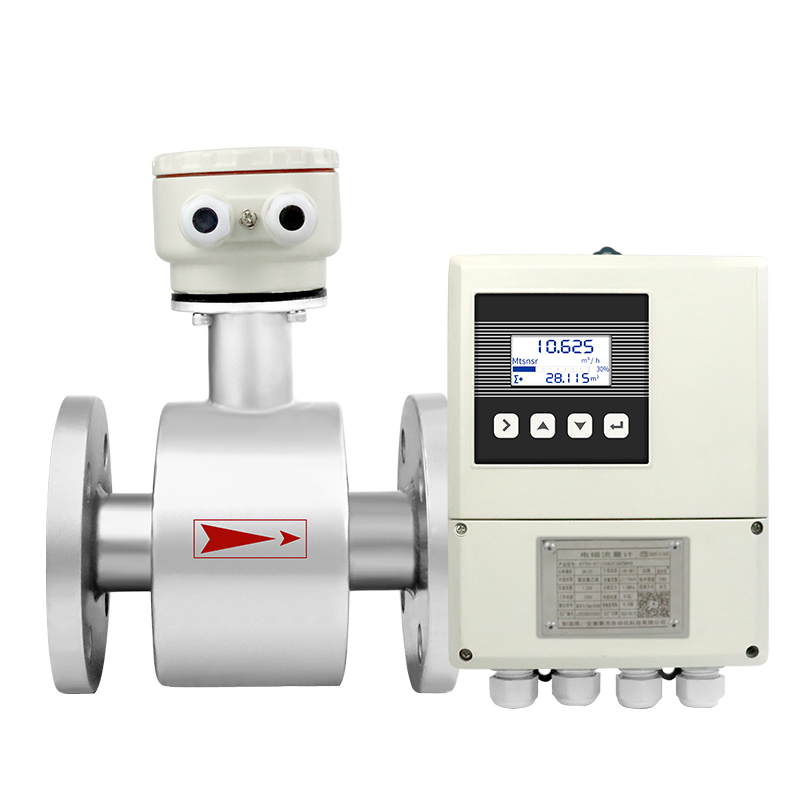
The electromagnetic flowmeter operates based on Faraday's law of electromagnetic induction. Its core structure consists of a measuring tube, an excitation coil and electrodes. When applied in the pulping process, the measuring tube should be connected in series to the inlet pipe of the pulping tank or the pulping output pipe. When the conductive medium (water or water-containing electroslurry) flows through the measuring tube, the magnetic field generated by the excitation coil will cause the charge in the medium to deflect. The induced electromotive force captured by the electrode is directly proportional to the flow rate of the medium. After processing by the converter, real-time flow data can be output.
The advantage of this type of flowmeter lies in the fact that there are no mechanical moving parts inside the measuring tube, which can effectively avoid the clogging problem caused by fiber entanglement. It is suitable for monitoring the output of slurry with a high fiber content, and its measurement accuracy can reach ±0.5%, meeting the strict requirements of the pulping process for flow control.
2. Vortex flowmeter - Efficient monitoring of clear water and low-viscosity slurry
The vortex flowmeter calculates the flow rate by detecting the Karman vortex street frequency generated when the fluid flows through the vortex generator. Its structure consists of a vortex generator, a sensor and a converter. It is widely used in the water inlet stage of the pulping tank. When clear water flows through the vortex generator in the pipeline, vortices are alternately generated on both sides of it. After the sensor captures the vortex frequency, based on the relationship that "frequency is proportional to flow rate", the converter calculates the flow rate value and transmits it to the control system.
The vortex flowmeter features a fast response speed, the ability to monitor the instantaneous changes in the influent flow in real time, and is easy to install and maintain with relatively low costs. However, due to its measurement accuracy being easily affected by the viscosity of the medium, it is more suitable for flow monitoring of low-viscosity media such as clear water and is not suitable for output pipelines of high-fiber content slurries.
2.2 Ultrasonic Flowmeter - A flexible non-contact monitoring option
Ultrasonic flowmeters use a non-contact measurement method. They emit ultrasonic waves into the pipe through a probe and calculate the flow velocity based on the time difference of ultrasonic wave propagation in the fluid. In the pulping process, the probe can be installed on the outer wall of the circulating pipeline of the pulping barrel or the large-diameter pulping material conveying pipeline without damaging the pipeline structure, thus avoiding the problems of pulping material leakage and component wear.
Its advantage lies in its strong adaptability, which can be adapted to pipes of different diameters and is not affected by impurities or fibers in the medium. However, the measurement accuracy is greatly influenced by the material of the pipe, wall thickness and the content of bubbles in the medium. It is necessary to precisely calibrate the pipe parameters before installation and is usually used for auxiliary monitoring or flow detection of large-diameter pipelines.
3. Key precautions for the application of flowmeters in the pulping process
To ensure the stable operation of the flowmeter in the pulping scenario and provide accurate data, the following key application points need to be focused on:
3.1 Reasonable selection of suitable medium characteristics: Choose the type of flowmeter based on the monitoring object. For high-fiber and high-viscosity slurry output pipelines, electromagnetic flowmeters are preferred. Vortex flowmeters can be selected for the clean water inlet pipeline. Ultrasonic flowmeters are suitable for large-diameter circulating pipelines or pipelines that are not easy to disassemble and modify, to avoid measurement deviations or equipment failures caused by improper selection.
3.2 Standardized installation ensures measurement accuracy: During installation, it is necessary to ensure that there are sufficient straight pipe sections before and after the flowmeter (generally, the length of the front straight pipe section should not be less than 10 times the pipe diameter, and the length of the rear straight pipe section should not be less than 5 times the pipe diameter), to avoid the flow field interference caused by pipe elbows and valves affecting the accuracy of the data. The electromagnetic flowmeter must ensure that the measuring tube is filled with medium to avoid measurement failure caused by empty tube operation.
3.3 Regular maintenance to adapt to working conditions: In the pulping environment, slurry is prone to residue. It is necessary to clean the electrodes of the electromagnetic flowmeter regularly to prevent fiber adhesion from affecting the capture of induced electromotive force. Inspect the vortex generator of the vortex flowmeter to prevent the accumulation of impurities from altering the flow field characteristics. Ultrasonic flowmeters need to regularly calibrate the coupling state between the probe and the pipeline to ensure stable ultrasonic transmission.
3.4 Interlocking control for closed-loop management: Interlock the flowmeter with the inlet valve of the pulping tank, the discharge pump and the stirring system to build a closed-loop control system. When the flowmeter detects that the flow rate deviates from the process set value, the system automatically adjusts the valve opening or the pump body speed, while optimizing the stirring rate to ensure the dual stability of the slurry concentration and the conveying flow rate.
4. In conclusion, as the "flow perception core" in the production process of papermaking pulping barrels, the scientific selection, standardized installation and timely maintenance of flowmeters directly affect the stability of the pulping process and the quality of paper. Through the selection of flowmeters that are compatible with the characteristics of the medium, precise installation and commissioning, as well as in-depth interaction with the control system, the full-process precise control of flow in the pulping process can be achieved, providing a solid guarantee for the efficient production of the papermaking industry.